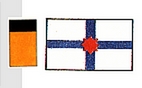
 The middle decades of the 19th Century saw maritime entrepreneurial activity flourish on and from the Australian coast. In South Australia, the major pastoral and agricultural interests, particularly those producing wool, anxious to accelerate their trade with Europe, acquired their first steamship in the mid-1850s. Increased activity, including mining resulted in the acquisition of more vessels, sail and steam, and coastal trading was extended.
The Adelaide Steamship Company Limited (“The Adelaide Company”), emerging from this background, was floated in 1875, a contemporary of the New South Wales and Victorian goldrushes.
Scores of ships passed through the Company’s hands, providing the full range of maritime trials and tribulations and requiring constant determination, perserverance and vision in the face of misfortunes of weather, the pressures of competition and the vagaries of industrial outlook.
Smaller, earlier-formed shipping companies, some dating from 1875, coalesced in 1912 into the Coast Steamships Company, this in turn being taken over by the Adelaide Company in 1915.
The Adelaide Company’s ships contributed to the national effort during the Great War, with Grantala at risk while supporting the Expeditionary Force landing at Rabaul, and Willochra requisitioned in November 1914, Wandilla in May and Warilda in August 1915 for trooping, the last two being converted to hospital ships in August 1916. Warilda was sunk by a submarine on 2 August 1918.
The Second World War was upon the world all too soon and at its start, the Company owned thirty ships:
| Ship | Built | Gross Tons | In Service |
| Quorna | 1912 | 606 | 1913-1950 |
| Aroona | 1918 | 3116 | 1921-1949 |
| Aldinga | 1920 | 3078 | 1921-1951 |
| Oorama | 1921 | 1051 | 1921-1949 |
| Wortana | 1875 | 228 | 1922-1957 |
| Allara | 1924 | 3279 | 1924-1952 |
| Arkaba | 1924 | 4211 | 1924-1952 |
| Ulooloo | 1924 | 3236 | 1924-1957 |
| Dilga | 1920 | 3308 | 1925-1953 |
| Dundula | 1920 | 3344 | 1935-1953 |
| Mulcra | 1925 | 1175 | 1925-1961 |
| Kapara | 1914 | 846 | 1926-1942 |
| Broadway | 1921 | 738 | 1926-1953 |
| Goondi | 1923 | 346 | 1926-1955 |
| Noora | 1924 | 1072 | 1926-1956 |
| Mundalla | 1926 | 3018 | 1926-1959 |
| Momba | 1926 | 3021 | 1926-1954 |
| Katoora | 1927 | 327 | 1927-1960 |
| Minnipa | 1927 | 2014 | 1927-1960 |
| Terka | 1925 | 430 | 1928-1945 |
| Toorie | 1925 | 415 | 1928-1956 |
| Manunda | 1929 | 9155 | 1929-1956 |
| Tolga | 1925 | 418 | 1930-1946 |
| Moonta | 1931 | 2693 | 1931-1955 |
| Manoora | 1935 | 10856 | 1935-1961 |
| Beltana | 1937 | 3043 | 1937-1963 |
| Bungaree | 1937 | 3043 | 1937-1957 |
| Barossa | 1938 | 4239 | 1938-1963 |
| Bundaleer | 1939 | 4238 | 1939-1960 |
| Morialta | 1940 | 1365 | 1940-1957 |
| Coast Steamship Limited owning: | |||
| Karatta | 1907 | 493 | 1907-1961 |
| Warrawee | 1909 | 423 | 1909-1953 |
| Kopoola | 1912 | 293 | 1912-? |
| Kooraka | 1925 | 300 | 1925-? |
| Yandra | 1929 | 919 | 1929-? |
Government requisitioning of ships to meet its war needs commenced early for the Adelaide Company, with Manoora going in October 1939 for conversion to an Armed Merchant Cruiser and Manunda in May 1940 to become a Hospital Ship. Morialta, being built in the United Kingdom, was taken over on delivery in 1940 for British Ministry of War Transport use in transporting personnel, and after a somewhat eventful several years, was handed to its owners in 1947.
1941 saw Terka, Toorie and Tolga requisitioned by the Royal Australian Navy for service as Auxiliary Vessels, Terka not surviving the war due to collision and sinking at Madang in March 1945; Bungaree’s requisition tasked her initially as a Minelayer, her role being changed in 1944 to that of Stores Carrier. The United States Army Small Ships Command took over Wortana, Noora, Mulcra and Katoora in November 1942.
Three Coast Steamships’ vessels served under requisition: Warrawee as an Examination Vessel, Kooraka and Yandra as Minesweepers.
The remainder of Company’s fleet plied their quiet, vital but vulnerable, trade on the coast and surrounds in an infinite diversity of situations. Generally fitted with some limited defensive measures, not all came through unscathed. Barossa was one of the many vessels in Darwin Harbour when the first Japanese air raids came on 19 February 1942. She suffered severe damage in her own right and from proximity to other casualty vessels and it was nearly three months before she reached Sydney for major repairs. She returned to service in March 1943. The 23 July 2023 found Allara off Newcastle, where she was torpedoed by a Japanese submarine with the loss of five crew. Towed to Sydney for repairs, she returned to service in April 1943.
The Company’s largest ships were perhaps the best known during the war years as well as in peacetime, and they contributed significantly to the national war effort. Following its 1940 handover, Manoora (with previously a passenger capacity of 380) patrolled and escorted in Asian and North East Australian waters before being re-converted for service from early 1943 as a Landing Ship, Infantry for participation in successive “island-hopping” landings by Australian and allied troops. 1945 saw her transporting Australian service personnel back home, from Asia and the Pacific Islands. Voyages in the following two years included troop deployments to the Australian Component of the British Commonwealth Occupation Force in Japan and repatriation of allied personnel to the Netherlands East Indies. After post-war refit, she was handed back to owners in August 1949.
Manunda, with peacetime passenger capacity of 312, commenced her Hospital Ship role by bringing Australian wounded back from the Middle East. In Darwin in February 1942, having been unable to complete a Sydney-Singapore voyage, she was not attacked at the start of the initial air raid, but soon after suffered a direct hit, killing twelve and causing fire. Taking aboard casualties for evacuation south during the day, she later sailed under great difficulty for Fremantle and repair. Service in the Milne Bay and successive island battle areas culminated in participation in the repatriation of released Australian prisoners of war from Singapore and the deployment to Japan of medical elements of the Ausralian Component of the British Commonwealth Occupation Force. Hand-back to owners occurred in September 1946.