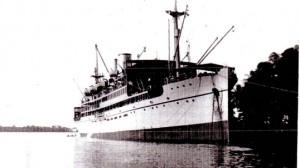
I joined the Malaita as 4th Engineer on the 15th July 1941 after having spent nearly four years in British ships running between the U.K, New Zealand, River Plate and Australian ports, so voyaging to Papua New Guinea and the Solomon Islands, prior to Japan entering the war, was a new and novel experience. This was borne out when entering Port Moresby harbor for my first time, in early morning darkness one of the cadets warned me to be careful of the trams when crossing the road! I soon learned the facts.
The next novel experience was running around the Solomon and stopping often as four times an a day to deliver stores and refrigerated cargo, particularly meat, to many plantations and picking up copra by means of surfboats, towed to the ship by motor launch. A far cry from the refrigerated cargo being sealed up in the “Pommy” ships for a 30 days non stop run from Fremantle around the Cape of Good Hope to the U.K.
Another eye opener was to see the Master, Captain Bill Wilding going out on to reefs in a surf boat to collect tropical fish which were placed in several small ranks on the after deck, for the ultimate delivery to the Aquarium at Taronga Park Zoo. The engineers had to ensure that sea water to the deck fair main and the fish tanks was uninterrupted, irrespective of engine room needs.
After three trips, I left the Malaita on the 2nd December 1941 to sit for my First Class Motor Certificate and to get married.
I then worked with the shore squad on ships repairs whilst waiting for a new posting and eventually joined the MV Macdhui as 3rd Engineer on the 2nd June 1942. Our departure was delayed by the entry of Japanese midget submarines into Sydney Harbour, but we final got away bound for Port Moresby. This was to be my shortest voyage.
The story of the bombing on the 17th and 18th June with the ultimate burning and sinking on to a reef in Prot Moresby Harbour has been well documented, together with Damein Parer’s fantastic newsreel films, which I am fortunate enough to have a copy of and also the report to the company by Mr. A. E. Walsh, the Chief Engineer who gives a detailed account of the events and damage to the ship.
As the bombs had hit both forward and aft of the engine room, we engineers were fortunate not to sustain any physical injury, but there was a fair amount of shock damage to various machinery items. The bridge to engine room telegraph, telephone and speaking tube were smashed, so we did not know the extent of the damage and fore to the rest of the ship.
As the main engine had stopped without the 2nd Engineer Jock Burnett having operated the controls we assumed that the shock damage may have broken a fuel pipe and were investigating the problem when one of the Deck Officers came in to the top of the engine room and called out abandon ship.
When we came out on to the deck we were shocked to see the ship ablaze from stem to stern and at the intensity of the flames which were being fuelled by the 1900 drums of aviation spirit remaining undischarged in the holds. We escaped by a rope ladder into a RAAF launch one of several services small craft assisting in rescuing survivors. It was then that we learned that the main engine had been stooped by one of the Deck Officers operating the deck emergency control, to shut off the supply of oil fuel to the main engine and as the telephone and speaking tube were smashed, they were unable to advise us as to what had been done.
This system of stopping the main engine (s) had been devised on account of accidents in the early days of the war, when lifeboats had been overturned or were not able to be launch because the engine (s) were still running and keeping the ship under way.
On reaching the shore and after a de-briefing by a senior army officer, the uninjured survivors were formed into small groups and allocated to various army units in the area. The engineers were sent out to a light anti-aircraft unit (Bofors guns) on a hill overlooking the Seven Mile Drome (now the Jackson Airport).
As most of us had escaped clad only in boiler suits, the army, Salvation Army and Australian Comforts Fund supplied us with cloths and boots.
On the 21st June we were put aboard the Dutch ship Swartenhondt and taken to Townsville, arriving on the 25th June, from there we were put on a special troop train bound for Brisbane. We must have been shunted on to every siding on the way, as due to the position of the Japanese on P.N. G. at the time, we had to give way to all north bound traffic. Eventually we arrived in Brisbane and after an over night stay in The Peoples Place (Salvation Army) we joined a NSW Railways train for the final leg to Sydney.
I next joined the old SS Montoro on the 5th October 1942 as 4th Engineer and stayed for six voyages until the 6th march 1944 during which time I was elevated to 3rd and 2nd Engineer after gaining my First Class Steam Endorsement. The most unusual events during this period were:
- When we arrived the first ships to take supplies into Milne Bay after the Anshun had been shelled by a Japanese cruiser and was lying on her starboard side a short distance off the wharf. We berthed alongside the bottom of the hull and unloaded the cargo on to her port side
- Brought some of the first lost of Japanese and Korean prisoners of war from Port Moresby to Cairns. The Army have found the tallest and heaviest military police to guard them and the comparison between the M. P. ’s and the POW’s was almost funny.
- During a practice shoot with the Vickers machine guns mounted on top of the Engineers accommodation one of my colleagues accidentally shot a hole through the mainmast forestay, much to the Mates horror.
I left the Montoro when I was seconded to the Ministry of Munitions, but retained my contact with Burns Philp ships when in 1946 I become a Lloyd’s Surveyor for 33 years.